 DAKERA
22 Production Patterns
Memory Patterns Library
Production-ready patterns for building AI agent memory systems. Each pattern includes the problem, architecture, and working Dakera implementation code.
Start here
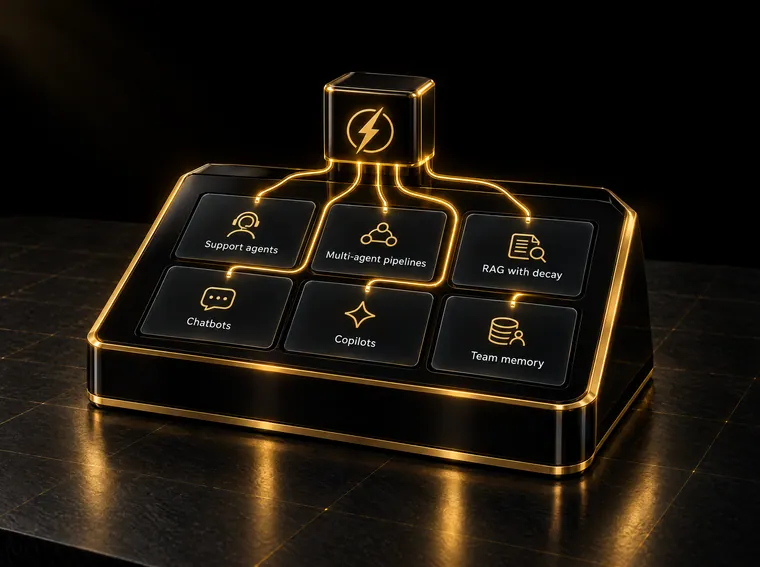
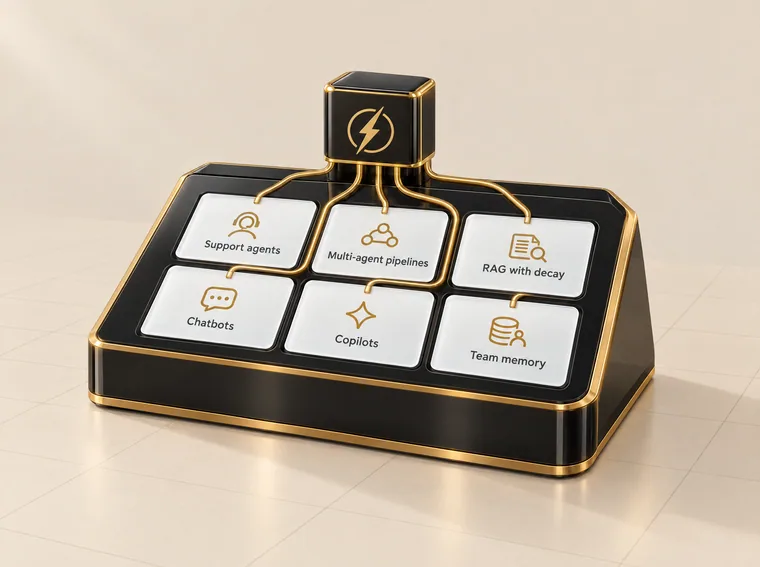
What developers build with persistent memory
From solo agent projects to production multi-agent pipelines. Six starting points, each with a working implementation.
Agents with persistent memoryA support agent learns preferences on session 1 and applies them on session 100.User preference recall →
Multi-agent knowledge pipelinesA researcher stores findings; a writer recalls them by meaning in the next task.Multi-agent shared memory →
RAG with decay-weighted recallFresh sources surface, stale ones sink. Retrieval stays relevant without curation.RAG-augmented memory →
Chatbots that remember preferencesPersonalization that compounds across weeks, without prompt engineering.Cross-session context →
Copilots that learn your workflowsNaming conventions, architecture decisions and library patterns, learned via MCP.Tool usage learning →
Team memory for LLM dev toolsNew engineers query the same memory experienced ones have been building.Hierarchical memory →
Retrieval
User Preference Recall
Store and retrieve user preferences across sessions. Personalize responses based on accumulated knowledge of individual users.
Retrieval
Cross-Session Context
Maintain conversation continuity across disconnected sessions. Resume context without requiring users to repeat themselves.
Architecture
Multi-Agent Shared Memory
Enable multiple agents to share and build on each other's memories while maintaining isolation where needed.
Lifecycle
Conversation Summarization & Decay
Automatically consolidate verbose conversation logs into concise summaries while letting low-importance details decay over time.
Knowledge
Knowledge Graph Entity Linking
Extract entities from memories and link them into a traversable knowledge graph for multi-hop reasoning.
Retrieval
Temporal Event Tracking
Track events over time and answer temporal queries like "what changed last week" or "when did the user start using X".
Lifecycle
Importance-Based Forgetting
Score memories by importance and let low-value ones decay. Configure decay strategies to mimic natural human forgetting curves.
Architecture
Namespace Isolation
Isolate memory by user, tenant, or agent using namespaces with scoped API keys for secure multi-tenant deployments.
Architecture
Session Handoff
Transfer conversation context between agents or sessions. Enable seamless escalation from bot to human or between specialized agents.
Lifecycle
Semantic Deduplication
Detect and merge semantically similar memories to prevent redundancy and keep the memory store clean and efficient.
Retrieval
RAG-Augmented Memory
Combine persistent agent memory with document retrieval for richer, more accurate context in LLM responses.
Lifecycle
Memory Conflict Resolution
Detect and resolve conflicting memories when users change preferences or provide contradictory information over time.
Architecture
Hierarchical Memory
Organize memory into tiers — short-term conversation, long-term facts, and permanent identity — with different retention policies.
Agent Behavior
Tool Usage Learning
Agents learn which tools work best for which tasks by storing outcomes and recalling successful patterns for similar queries.
Agent Behavior
Emotional Context Tracking
Track user sentiment across conversations to adjust tone, pacing, and response style for better user experience.
Optimization
Memory Compression
Consolidate verbose memories into concise summaries to reduce storage while preserving key information for future recall.
Retrieval
Episodic Replay
Replay past interactions in sequence to understand how context evolved over time within and across sessions.
Agent Behavior
Goal Tracking
Track user goals across conversations with status management — active, completed, or abandoned — for continuity in long-running work.
Agent Behavior
Feedback Loop Memory
Store user corrections and feedback to avoid repeating mistakes and continuously improve response quality over time.
Optimization
Context Window Management
Rank and trim recalled memories to fit LLM token budgets while maximizing relevance of injected context.
Security
Memory Permissions
Implement role-based access control on memories using namespaces and scoped API keys for secure multi-tenant systems.
Operations
Batch Ingestion
Bootstrap agent memory from existing data sources — CRM exports, chat logs, documentation — with chunking and metadata tagging.
Further reading: How Agent Memory Works · Memory Decay & Temporal Weighting · Knowledge Graphs for AI Agents · Multi-Agent Memory Systems · Quickstart Guide
Try it live
Run this pattern against a real Dakera.
The Playground executes live API calls in your browser. No account, no install. Then run it on your own server in five minutes.
Prefer managed hosting? Join the Dakera Cloud waitlist →